
For years, SaaS CTOs focused on system reliability. Uptime, latency, error rates. The tooling matured. Practices stabilized. Reliability became expected. The next frontier is not infrastructure. It is metrics.
Modern SaaS companies run on numbers. Revenue, activation, retention, usage, cost efficiency. These metrics drive product decisions, pricing, forecasting, and investor narratives. When metrics are unreliable, decisions are distorted, even if systems are technically healthy.
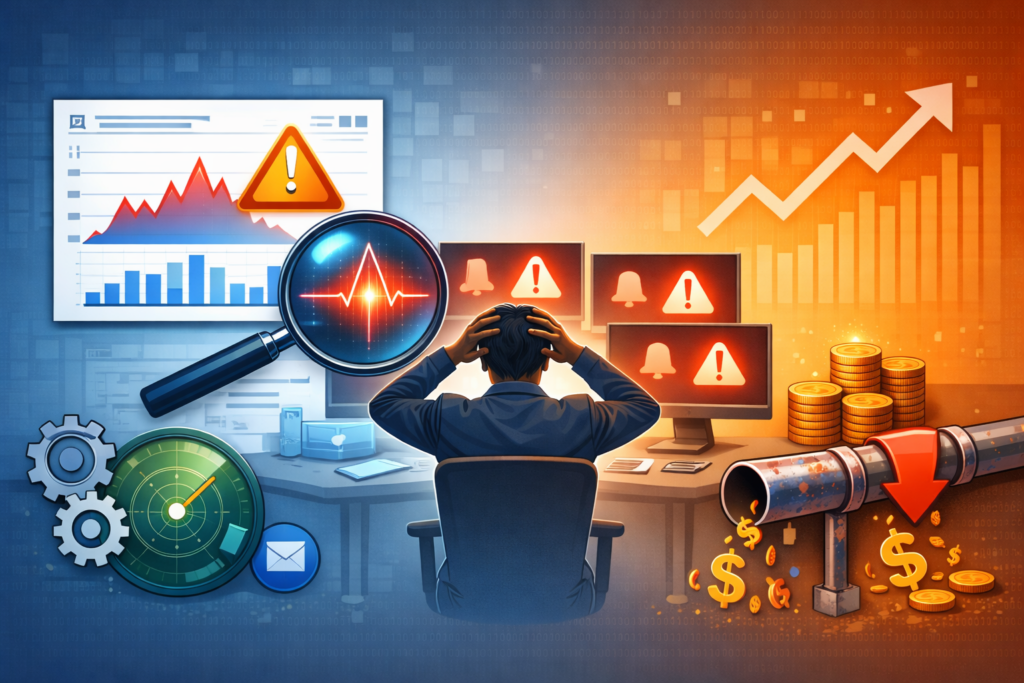
Metric reliability is not about correctness in isolation. A metric can be technically accurate and still unreliable as a decision signal. Late updates, silent data drift, broken pipelines, or unobserved anomalies all reduce trust. Teams stop acting on data not because it is wrong, but because it is unpredictable.
This problem grows with scale. As data pipelines become more complex, more things can subtly fail. A schema change upstream shifts a calculation. A delayed batch job skews daily numbers. A traffic change alters baseline behavior. Dashboards still load. Numbers still move. But confidence erodes.
CTOs are uniquely positioned at this boundary. Metric reliability sits between engineering, data, and the business. It is not owned cleanly by any single team. Without explicit ownership, it becomes everyone’s problem and no one’s priority.
The impact is strategic. Product teams hesitate. Finance double-checks. Executives ask for reconciliations instead of insights. Speed drops. The company becomes data-rich but decision-poor.
Ensuring metric reliability requires moving beyond passive reporting. Dashboards show values. They do not validate behavior. Reliable metrics need continuous monitoring for abnormal changes, unexpected patterns, and upstream issues before numbers reach decision-makers.
This is where anomaly detection becomes foundational. Not as an ML experiment, but as an operational control. Reliable metrics are monitored like production systems. Deviations are detected early. Issues are surfaced with context. Trust is maintained even as complexity increases.
Platforms like AnomalyGuard address this gap by continuously monitoring metric behavior across the data stack. They help SaaS teams detect when metrics stop behaving as expected, before those metrics drive bad decisions.
Infrastructure reliability is now table stakes. Metric reliability is becoming the differentiator. CTOs who invest here enable faster decisions, higher confidence, and tighter alignment between data and reality.
As SaaS companies scale, the question is no longer whether you have metrics. It is whether you can trust them when it matters most.
A quick diagnostic
Ask yourself:
Which business decision last quarter relied on metrics you did not fully trust?
If the answer is “more than one,” metric reliability is already a bottleneck.
A focused review of how metrics are monitored, not just computed, often reveals where trust is leaking.
That is where the next gains usually come from.