
Today, many companies are doing everything “by the book.”
Their data is high quality, well prepared, and available in the right form. Modern BI tools, AI, and ML solutions are in place. Governance is defined, access rights make sense. And yet, in practice, things still grind. Data and BI fail to deliver the value they clearly could and should.
In most cases, this is not a technology problem.
It is not a process problem.
And often it is not even a governance problem.
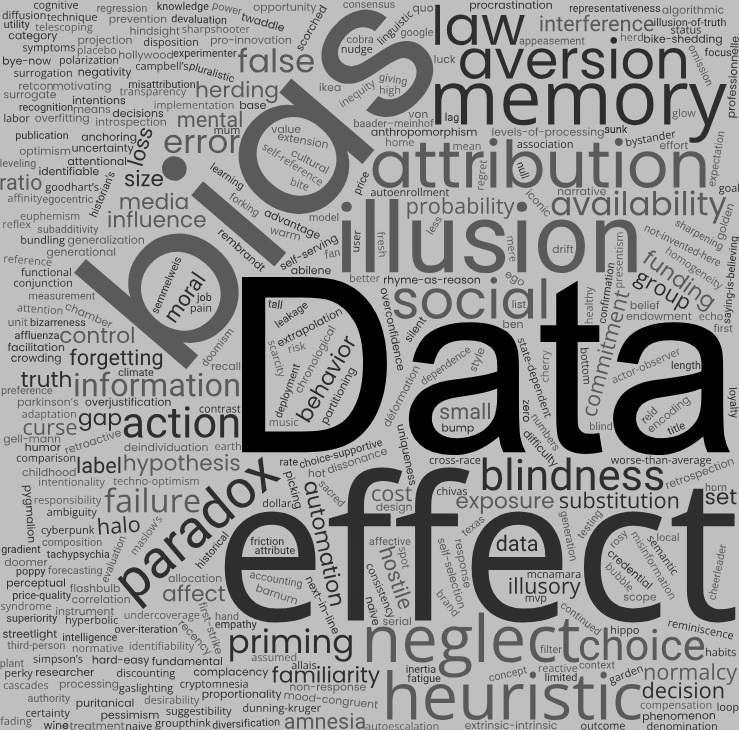
There is one more layer that is rarely discussed. I personally call it data biases.
These are systematic distortions in how we read data, interpret it, and make decisions based on it. They affect analysts, managers, and entire teams alike. Seniority does not protect you. Experience does not eliminate them. And believing you are “data-driven” does not make you immune.
I have always been interested in this topic. Over time, I collected notes about biases in an ad-hoc way, mostly alongside real work with data. Gradually, I started noticing how these biases influence not only people around me, but also my own thinking and decision-making. The most valuable moments were when I discovered a bias that perfectly described my own blind spots or distorted view of reality. Uncomfortable, but extremely useful.
Some biases are widely known, such as the Dunning–Kruger effect. Others are intuitively familiar, yet rarely named, like the Goal Gradient Effect. And some may be completely new to you if you have not encountered them before, for example the Modality Effect.
I decided to publish these insights as a series of posts. Each post will focus on one specific bias: a brief general explanation, how it manifests in data engineering, BI, and analytics, how to diagnose it in practice, and what can realistically be done about it.
Preparing this series genuinely excited me, and I hope it will be valuable for others working with corporate data as well. The series will start soon. If this topic interests you, feel free to follow my LinkedIn profile or the AnomalyGuard profile, where the posts will be published.
Data can be in perfect shape.
Decision-making often is not.
And that is where the real problem begins.