
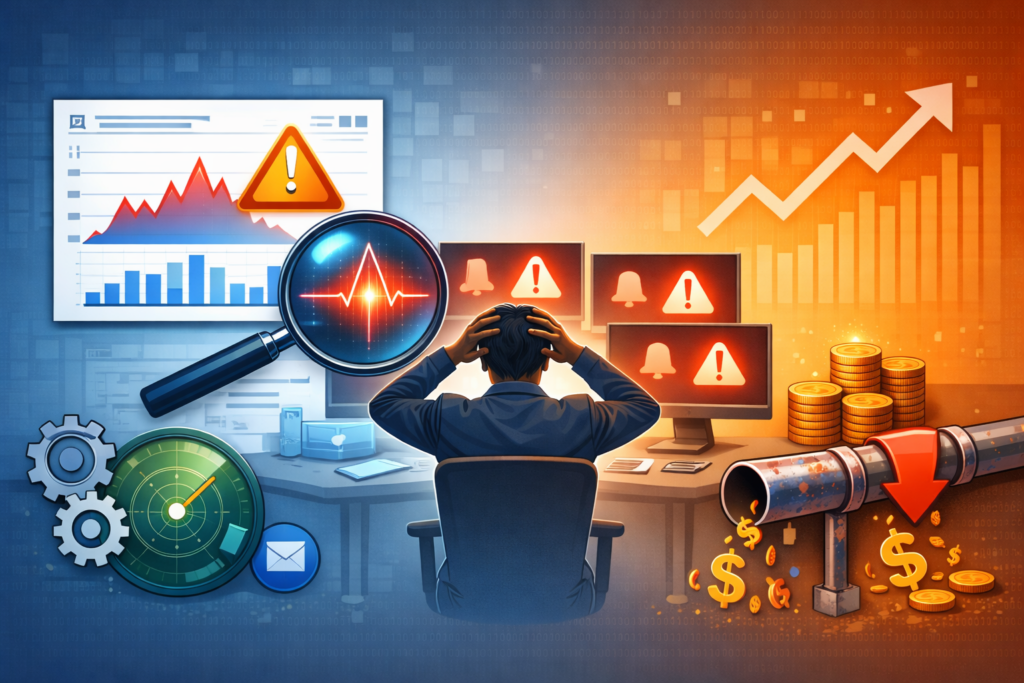
Manual alerting and dashboard monitoring rarely look like technical debt. They feel operational. Charts exist. Alerts fire. People respond. Nothing is obviously broken. That is exactly why the debt accumulates unnoticed.
Every manually defined alert encodes an assumption about the system. A threshold that once made sense. A metric that used to be stable. A pattern that matched historical behavior at a specific point in time. As systems evolve, those assumptions silently decay. The alert remains, but its relevance does not.
Over time, teams accumulate dozens or hundreds of alerts tied to dashboards that no one actively curates. Some alerts trigger too often. Others never trigger at all. Most sit in an ambiguous middle ground, occasionally firing but rarely with clear actionability. Engineers learn which alerts to ignore. This is not resilience. It is adaptation to debt.
Dashboards follow the same pattern. They grow by addition, not by design. New metrics are added to explain new features or incidents. Old ones are rarely removed. The result is a dense surface of charts that require constant human interpretation. Monitoring becomes a cognitive task rather than a reliable system.
This creates hidden coupling between people and systems. Knowledge of which dashboard matters, which alert is real, and which spike is noise lives in individual heads. When those people are unavailable, response quality degrades. The system technically still works, but operationally it depends on tribal knowledge.
The cost shows up in subtle ways. Slower incident detection. Longer time to root cause. Higher on-call fatigue. Increased risk during growth or change. None of these are traced back to dashboards or alerts, so the root cause remains unaddressed.
Manual monitoring also resists scaling. As data volume and system complexity increase, the number of potential failure modes grows faster than human attention. Teams compensate by adding more alerts, which increases noise and further erodes trust. The debt compounds.
Technical debt is not just messy code. It is any system design that requires increasing effort to maintain the same level of reliability. Manual alerting and dashboard-based monitoring fit that definition precisely.
The alternative is to shift from static rules to adaptive detection. Instead of encoding assumptions in thresholds, systems can learn normal behavior and flag deviations automatically. Instead of requiring constant human scanning, monitoring becomes event-driven.
This does not eliminate dashboards. It repositions them. Dashboards become tools for investigation and explanation, not the primary detection mechanism. Alerts become fewer, more meaningful, and more trusted.
Platforms like AnomalyGuard are designed around this shift. They reduce reliance on brittle thresholds and manual checks by continuously detecting abnormal behavior across metrics. The result is not just fewer alerts. It is lower operational debt and more predictable monitoring as systems evolve.
Ignoring this form of technical debt is easy because it does not break builds or block deployments. It simply slows teams down and increases risk quietly. Addressing it early is often one of the highest-leverage improvements a CTO or data leader can make.
A quick diagnostic
Ask your team:
Which alerts would you confidently delete today without increasing risk?
If no one can answer quickly, the debt is already embedded.
A short audit of alerts and dashboards often reveals how much monitoring depends on habit rather than signal.
That insight usually precedes meaningful simplification.