Growth puts immediate pressure on monitoring. More services. More data. More metrics. The default response is to add alerts and dashboards. That approach works briefly, then breaks. Engineering headcount does not scale at the same rate as system complexity.
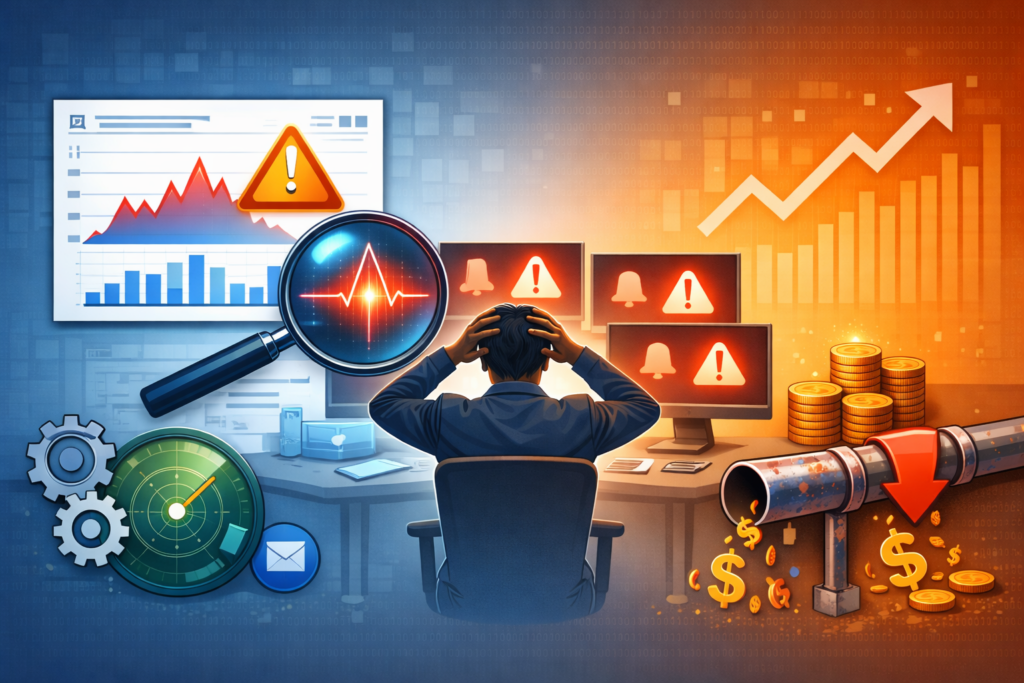
At early stages, monitoring is simple. A handful of services and KPIs can be watched manually. As the platform grows, monitoring effort grows non-linearly. Each new component introduces new failure modes. Each metric adds another thing to watch. Teams compensate by spreading responsibility, rotating on-call, and accepting more noise.
This is where scalability fails. Monitoring becomes a human bottleneck. Engineers spend increasing time triaging alerts, checking dashboards, and validating whether something is actually wrong. The system technically scales, but the team does not.
The core problem is that most monitoring strategies assume unlimited attention. Thresholds fire regardless of context. Dashboards require constant interpretation. As volume increases, signal-to-noise decreases. Engineers adapt by ignoring alerts, which increases risk.
Scaling monitoring without scaling teams requires changing what scales. Detection must scale with data, not with people. That means reducing reliance on static rules and manual checks and shifting toward automated detection that adapts as behavior changes.
Early anomaly detection enables this shift. Instead of adding more alerts for every new metric, systems learn what normal looks like and surface only meaningful deviations. This dramatically reduces alert volume while increasing relevance. Engineers respond to fewer signals, but with higher confidence.
This approach also protects teams from growth-related regressions. When traffic patterns change, new customers onboard, or systems are re-architected, anomaly detection adjusts automatically. Monitoring remains effective without engineers constantly re-tuning thresholds.
Platforms like AnomalyGuard are designed around this principle. They sit on top of existing data and monitoring stacks and scale detection automatically as metrics grow. Teams do not need to expand monitoring ownership or hire specialists to keep up with complexity.
The result is predictable operations. Monitoring keeps pace with the business, not with headcount. Engineers stay focused on building and improving systems instead of babysitting alerts.
Scaling is not just about infrastructure. It is about attention. Monitoring strategies that consume more attention over time are not scalable by definition. The only sustainable path is to make detection smarter as the system grows.
A quick diagnostic
Ask your team:
How many alerts did you receive last week that required no action?
If the number is high or unknown, monitoring is already scaling faster than your team.
Reviewing alert volume versus actionability is often enough to see whether automation would change the curve. That insight usually precedes real operational leverage.