
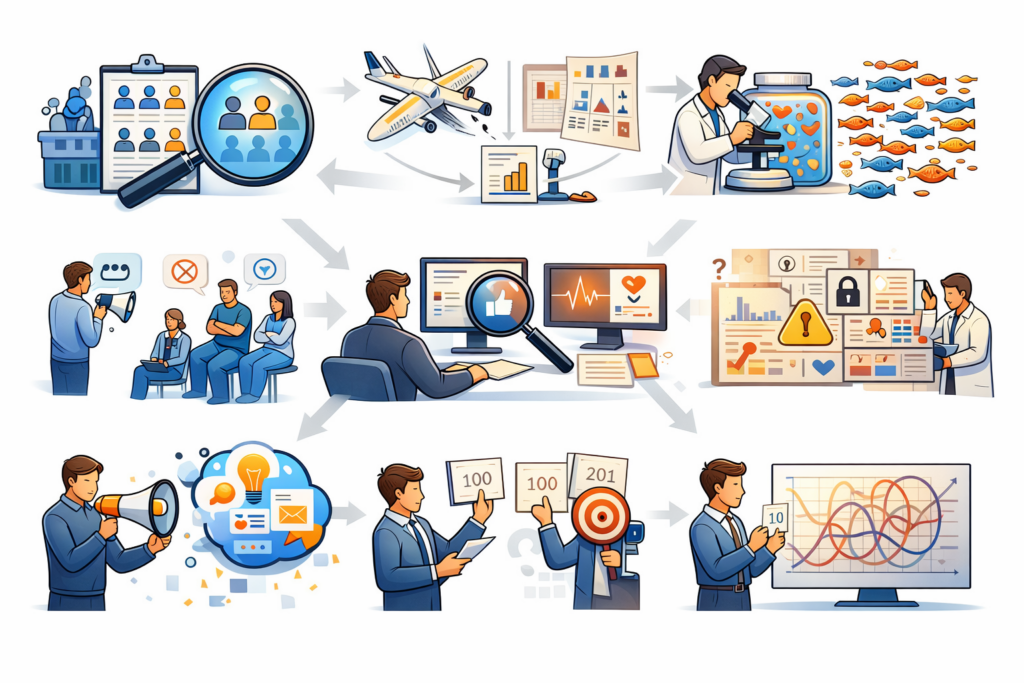
Responsibility Diffusion occurs when individuals or teams avoid ownership of decisions or tasks, often assuming that someone else will handle them. In data driven organizations, this bias can silently undermine analytics initiatives, BI projects, and operational efficiency.
In practice, Responsibility Diffusion manifests in multiple ways. In BI projects, a data analyst might assume that data quality issues will be resolved by the data engineering team, while the engineer expects the analyst to flag anomalies. Similarly, during dashboard development or report validation, stakeholders may defer accountability, believing another team is responsible for accuracy or insights. This can lead to delayed delivery, overlooked errors, and decisions based on incomplete or unreliable data. For example, a marketing analytics project may produce KPI dashboards that overstate performance because no one assumed responsibility for cross-checking source data.
To diagnose Responsibility Diffusion, look for patterns where tasks are repeatedly delayed, quality checks are skipped, or decision ownership is unclear. Surveys or retrospectives can reveal whether team members perceive accountability gaps. High reliance on assumptions that “someone else will handle it” is a clear warning sign.
Mitigating this bias requires explicit ownership assignments, clear roles, and accountability mechanisms. RACI matrices, peer reviews, and process checklists help ensure every task has a defined owner. Leadership reinforcement of personal accountability, coupled with cultural encouragement to raise issues proactively, reduces diffusion effects.
Awareness of Responsibility Diffusion highlights that effective BI and analytics depend not only on data quality but also on clear ownership and accountability. Even the best datasets fail to generate insights if no one takes responsibility for managing and interpreting them.