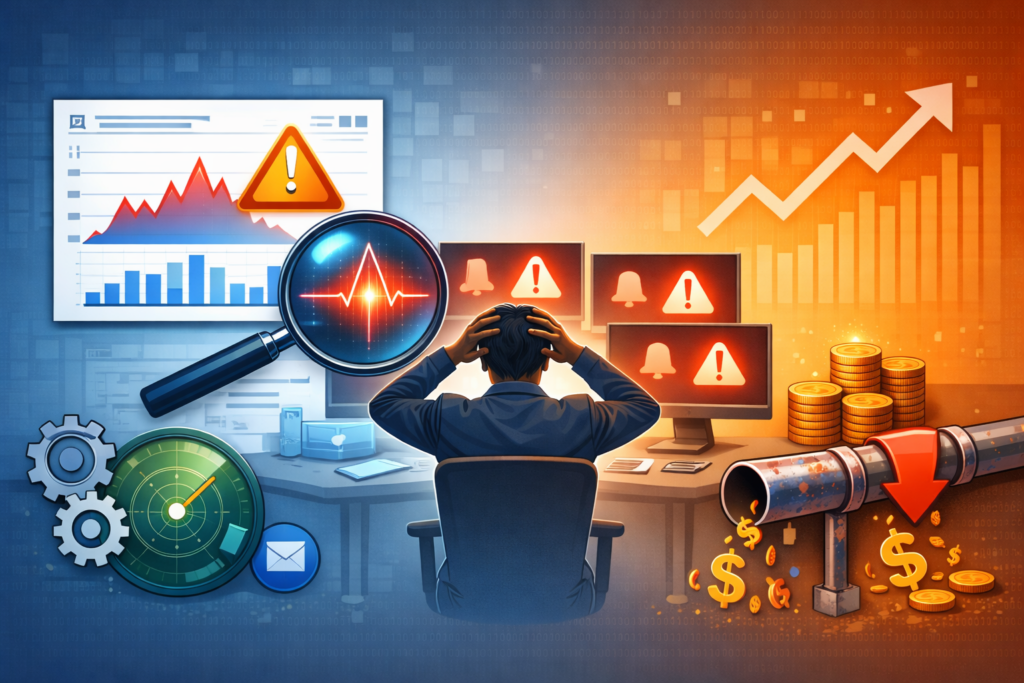
Manual metric monitoring feels responsible. Dashboards are checked. Reports are reviewed. Spreadsheets are updated. On the surface, it looks like control. In reality, it is one of the biggest hidden drains on productivity in data and engineering teams.
As systems grow, the number of metrics grows with them. What starts as a manageable set of KPIs quickly turns into dozens or hundreds of charts. Someone has to watch them. That responsibility usually falls on analysts, data engineers, or on-call engineers who already have full workloads. Time that should be spent improving systems or generating insights is instead spent scanning dashboards for anything that looks wrong.
The inefficiency is subtle. Each check takes only a few minutes. Each investigation starts with a quick look. Over a week or a month, those minutes add up. Teams lose hours to repetitive, low-value work that rarely prevents incidents. Most problems are still discovered after the fact, during reviews or postmortems.
Manual monitoring also scales poorly. As the business grows, the number of metrics increases faster than the team. More dashboards are added. More checks are required. The process becomes unsustainable, but it persists because there is no clear breaking point. Productivity declines gradually, not abruptly.
There is also a cognitive cost. Humans are not good at detecting small changes in noisy data. After looking at the same charts repeatedly, teams become desensitized. Only large, obvious shifts trigger attention. Subtle anomalies are missed, even when they are visible in hindsight. This creates a false sense of safety without delivering real protection.
Many teams try to compensate by adding checklists or rotating monitoring duties. This spreads the burden but does not solve the underlying problem. Monitoring remains manual, error-prone, and dependent on constant attention. When priorities shift or people are unavailable, gaps appear.
A better approach is to separate detection from inspection. Instead of asking people to watch metrics continuously, detection should be automated. Systems should monitor behavior in the background and notify teams only when something unusual happens. Humans should investigate and decide, not scan and guess.
Automated anomaly detection enables this shift. It continuously analyzes metric behavior and flags deviations that are unlikely to be normal. This removes the need for constant manual checks and allows teams to focus on higher-value work. When alerts arrive, they are more likely to matter.
The impact on productivity is immediate. Analysts spend less time monitoring and more time analyzing. Engineers spend less time reacting to noise and more time improving reliability. Teams regain focus without sacrificing visibility.
Dashboards still play a role. They are essential for exploration and explanation. But they are not an efficient monitoring strategy. Manual monitoring turns skilled teams into human sensors. Automation turns them back into problem solvers.
The question is not whether manual monitoring works. It clearly does not scale. The question is how long teams can afford the productivity loss before it becomes visible in missed opportunities and delayed improvements.
A quick diagnostic
Ask your team:
How many hours last week were spent just checking metrics rather than acting on them?
If the answer is “we don’t know,” the cost is already hidden.
Reviewing where monitoring time goes is often enough to see whether automation would free up meaningful capacity.
That reclaimed time is usually the fastest win.