
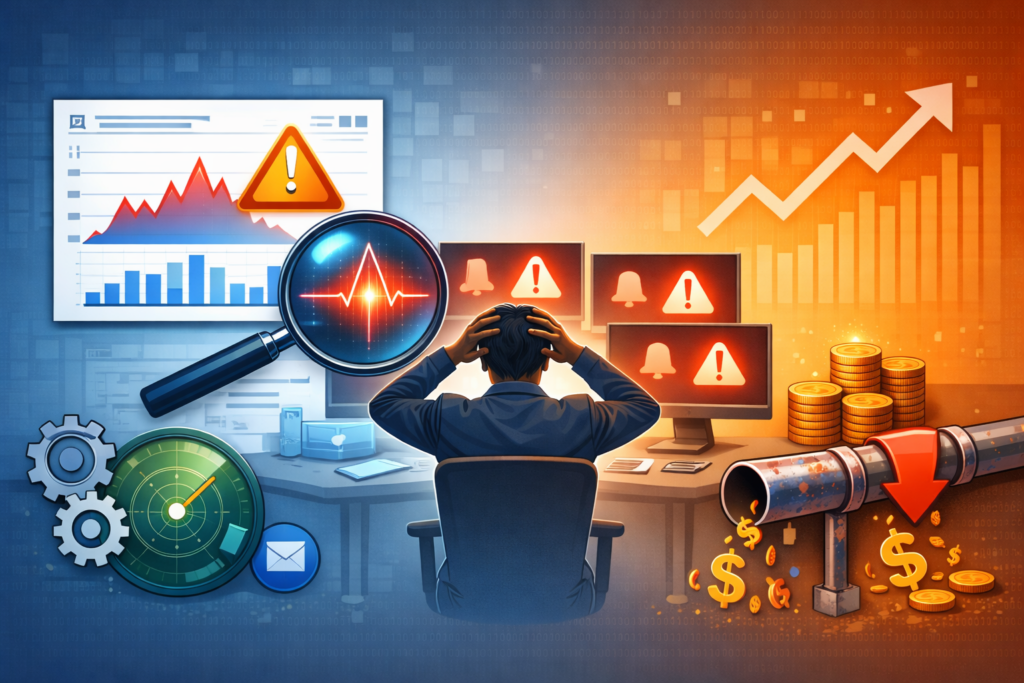
Most alerting systems fail for the same reason. They treat every change as equally important. As a result, teams drown in notifications while still missing what actually matters.
Noise comes from static rules applied to dynamic systems. Thresholds are set once and rarely revisited. Data behavior changes, but alerts do not. What was once abnormal becomes normal, and the system keeps firing.
Signal, on the other hand, is contextual. A small change can be critical if it is unexpected. A large change can be irrelevant if it follows a known pattern. Alerts that ignore context cannot distinguish between the two.
Dashboards do not solve this problem. They help explain alerts after the fact. They do not prevent noisy alerts from firing in the first place. Teams still spend time validating whether something is real.
Separating signal from noise requires shifting from rule-based detection to behavior-based detection. Instead of asking whether a value crossed a line, the system asks whether the behavior deviated from what is historically normal.
This reduces false positives immediately. Seasonal effects, growth trends, and regular fluctuations are absorbed into the baseline. Alerts fire only when something truly unusual happens.
Context matters as much as detection. An alert should explain what changed, where it changed, and why it matters. Without that, even accurate alerts feel noisy because they still require interpretation.
Platforms like AnomalyGuard address this by continuously learning metric behavior and surfacing only statistically meaningful deviations with context. Teams receive fewer alerts, but each one carries higher confidence.
The result is a change in behavior. Alerts are trusted. Response is faster. Attention is preserved for real issues.
Noise is not just a technical problem. It is an organizational one. When teams stop believing alerts, detection stops working.
Separating signal from noise restores trust in monitoring. That trust is what turns alerts into action.
A quick diagnostic
Ask your team:
Which alert do you ignore without checking the data?
If everyone has an answer, noise is dominating signal.
Reviewing ignored alerts is often the fastest way to identify where detection needs to change.
Fixing those first usually yields immediate gains.