
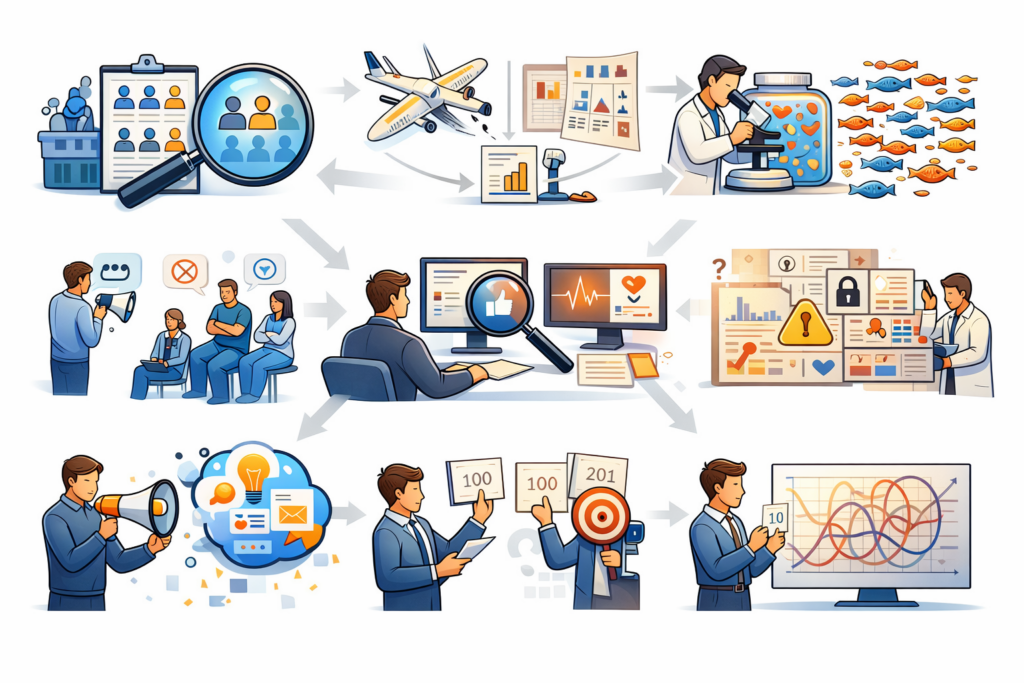
Herd Behavior is the tendency of individuals and organizations to imitate others’ actions, often without independent assessment of the facts. Decisions are made not because they are correct, but because others have done them. The sense of safety in numbers replaces analytical thinking.
In data, analytics, and BI, this bias appears prominently. Companies adopt the same tools, architectures, and methodologies simply because they are “industry standard.” Cloud-first, lakehouse, AI everywhere, real-time dashboards. The question “why do we need this?” is replaced by “why don’t we already have it?” Data initiatives then respond to trends rather than solving real business problems.
Herd Behavior undermines decision-making by weakening the link between data strategy and actual value. Organizations invest in solutions misaligned with their data maturity or needs. A common example is large-scale ML deployment without a clear use case, simply because competitors do it. The result is prototypes with low adoption, high costs, and frustrated stakeholders who “expected more.”
Diagnosis is surprisingly straightforward. Listen to the language used in decisions. Phrases like “everyone is doing it,” “it’s best practice,” or “our competitors have it,” without supporting data, are warning signs. Another indicator is the inability to clearly explain which metric the solution is intended to improve.
Mitigation requires returning to first principles. Start with the business question, not the technology. Demand clear hypotheses, measurable benefits, and pilot validation. Compare alternatives rather than following trends. Courage to go against the flow often becomes a competitive advantage in data. If your data strategy exists because others are doing it, you are not strategizing. You are following the herd.