
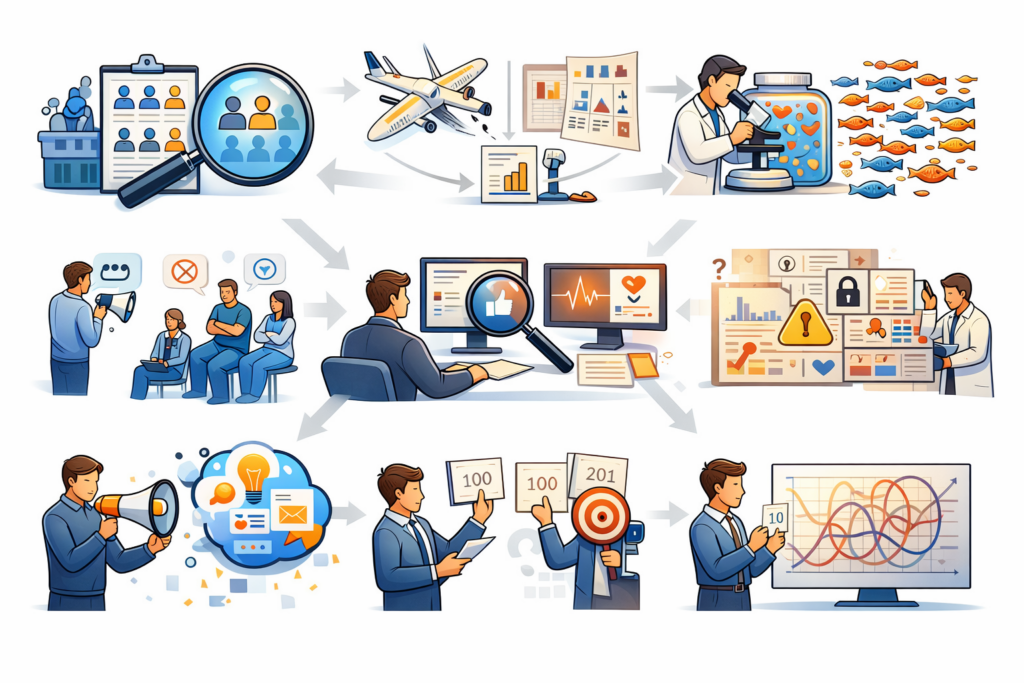
Group Polarization is a cognitive bias where discussions within a group lead to more extreme or radical positions than individuals would hold on their own. This occurs due to social pressure, the need for conformity, and selective reinforcement of shared opinions.
In data analytics and BI, this bias appears during team decisions on data interpretation, metric selection, or report design. For example, when discussing customer data trends, teams may focus on extreme evaluations – either overly optimistic or pessimistic – rather than maintaining an objective perspective. Group discussions often amplify the majority view while marginalizing minority opinions that could highlight risks or alternative interpretations.
The consequence is skewed decision-making and increased risk. Managers and analysts may act based on extreme scenarios, ignoring realistic probabilities or uncertainty. In practice, this often occurs in investment decisions or KPI selection for new projects, where after team discussions, goals become overly ambitious and difficult to achieve.
Diagnosis involves observing discussion dynamics: if opinions become more extreme after debate or dissenting views are marginalized, the bias is active. Another indicator is when final decisions are more radical than individual prediscussion estimates.
Mitigation includes structured decision-making: allow anonymous individual assessments before group discussions, implement regular consistency checks, and foster discussion of uncertainty and alternative scenarios. Facilitators should actively seek dissenting opinions and highlight tendencies toward extremes.
Takeaway: group discussions can inappropriately push decisions to extremes. Structured and critical processes help preserve objectivity and the quality of data-driven decision-making.