
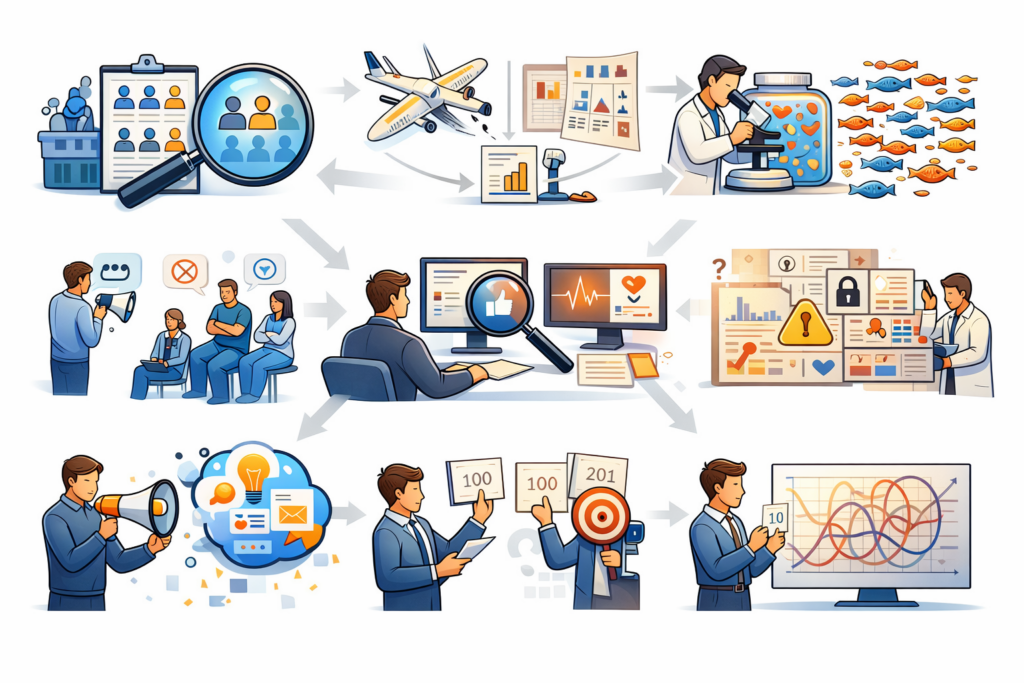
Group Attribution Error is a cognitive bias where we incorrectly assign the characteristics or behavior of a group to individuals within it. It simplifies mental models but ignores individual differences, leading to distorted evaluations.
In data analytics and BI, this bias appears when interpreting segmented data or making decisions based on averages. For example, if analysis shows a certain customer segment has high churn, managers may assume every individual in that group is a “high-risk” customer. In HR analytics, employees from a particular team or location may be judged based on team averages, overlooking individual performance.
The consequence is flawed decision-making and skewed insights. Organizations may implement interventions for all group members, rather than targeting real individual needs. In practice, this has appeared in marketing campaigns where segments were assumed to be homogeneous, resulting in lower effectiveness and unnecessary costs.
Diagnosis involves checking if the team understands data variability. If project members or managers simplify group results to the individual level without critical analysis, the bias is present.
Mitigation combines quantitative segmentation with individual-level analysis and visualizations showing dispersion, deviations, and outliers. Encouraging discussions about individual cases and educating the team on the risks of generalization significantly reduces the impact of this bias.
Takeaway: group-level data can lead to incorrect conclusions about individuals. Critical understanding of variability is key for accurate decision making in BI.