
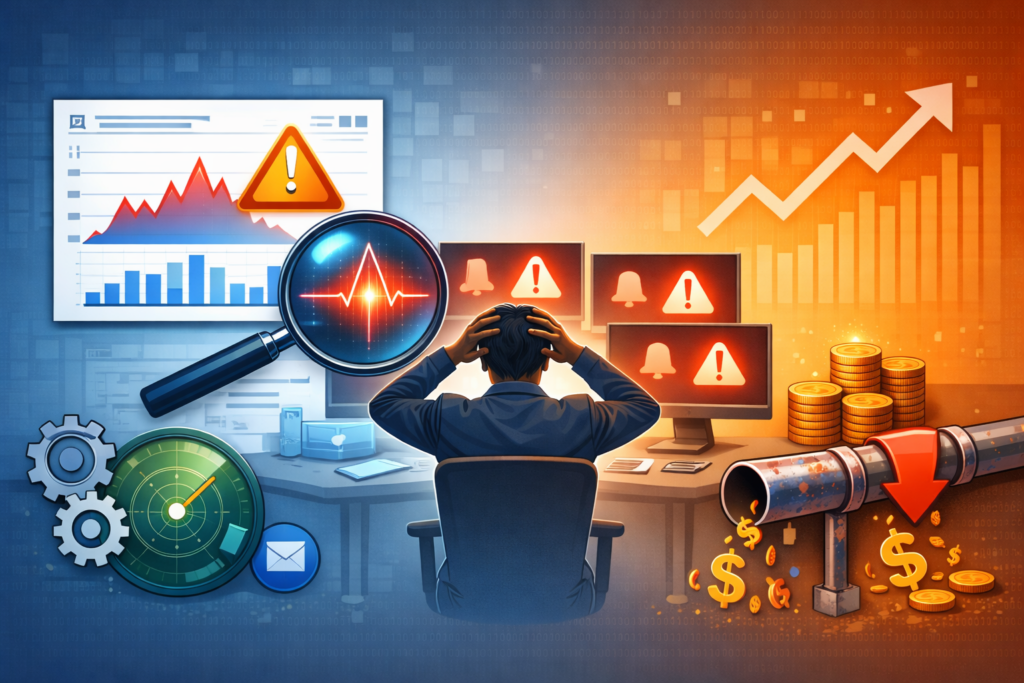
Most teams do not lack alerts. They lack actionable alerts. Notifications fire, dashboards flash, and people respond, yet the same problems keep reappearing. The system reacts, but it does not learn.
Firefighting is a symptom of poor signal quality. Alerts trigger when thresholds are crossed, not when something meaningful changes. Teams investigate spikes that turn out to be noise and miss slow deviations that cause real damage. Over time, response becomes mechanical. Alerts are acknowledged. Root causes are deferred.
Actionable alerts require context. Knowing that a metric moved is not enough. Teams need to understand whether the change is unusual, where it originates, and why it matters. Without that, every alert becomes a guess.
This is where many anomaly detection efforts fail. They detect anomalies but stop there. The alert says something is different, but not what to do next. Teams still have to dig through dashboards and logs to decide whether to act.
Foresight emerges when detection is paired with interpretation. Effective anomaly alerts answer three questions immediately. Is this change abnormal relative to history? Which dimensions or segments are driving it? What downstream metrics could be impacted?
When alerts provide this context, response shifts. Teams stop reacting defensively and start prioritizing. They can distinguish between transient noise and emerging issues. Investigation becomes targeted instead of exploratory.
Actionable alerts also change behavior over time. When alerts consistently lead to meaningful findings, trust increases. Teams respond faster because they expect value. Firefighting gives way to anticipation.
Platforms like AnomalyGuard are designed around this principle. They do not just flag anomalies. They surface contributing factors and affected metrics so teams understand impact quickly. Alerts become entry points into decisions, not distractions.
The operational payoff is significant. Fewer alerts. Shorter investigations. Earlier intervention. Problems are addressed before they escalate into incidents or KPI failures.
Foresight is not about predicting the future perfectly. It is about recognizing when the present stops behaving normally. Actionable anomaly alerts make that recognition reliable.
Teams that move from firefighting to foresight do not add more alerts. They make the existing ones matter.
A quick diagnostic
Ask your team:
How often does an alert lead directly to a clear action within minutes?
If the answer is “rarely,” alert quality is the bottleneck.
Reviewing recent alerts and their outcomes is often enough to see where context is missing.
That gap is usually where foresight begins.