
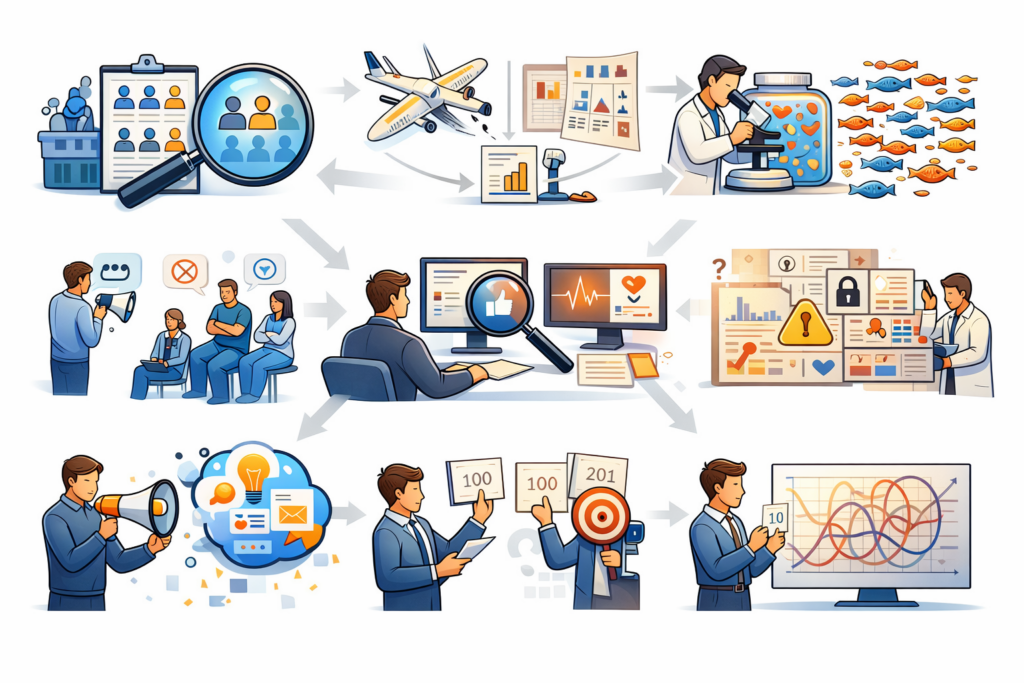
Echo Chamber Bias occurs when individuals or leaders selectively seek or value feedback that confirms their existing assumptions, ignoring contradictory perspectives. In business and data contexts, this bias can severely distort decision-making and strategy.
In data-driven environments and BI, Echo Chamber Bias often appears when founders, executives, or analysts rely on feedback from like-minded colleagues or selectively consume reports that reinforce prior beliefs. For instance, a product team may highlight only positive signals from user analytics while discounting critical metrics, leading to misguided prioritization or investment. Similarly, data scientists might favor model results that align with expected trends, neglecting anomalies or alternative hypotheses.
The consequences are significant. Echo chambers reduce organizational learning, amplify confirmation errors, and can result in repeated strategic mistakes. Decisions may appear validated internally while failing in practice because dissenting data or insights were ignored. A real-world example is a startup overinvesting in a feature validated only by internal enthusiasm, neglecting broader market feedback, leading to costly misalignment.
To diagnose Echo Chamber Bias, evaluate whether decision processes systematically exclude or devalue dissenting opinions. Monitor the diversity of feedback sources, compare assumptions to external benchmarks, and audit which insights are acted upon versus ignored.
Mitigation requires creating structured mechanisms to surface contrary evidence. Encourage cross-functional reviews, implement blind or anonymized data reporting, and formalize red-team analyses to challenge assumptions. Cultivating a culture where dissent is welcomed reduces the risk of selectively hearing only confirming signals.
Insight: Awareness of Echo Chamber Bias allows data and business leaders to expand perspective, act on holistic insights, and avoid the trap of self reinforcing assumptions.