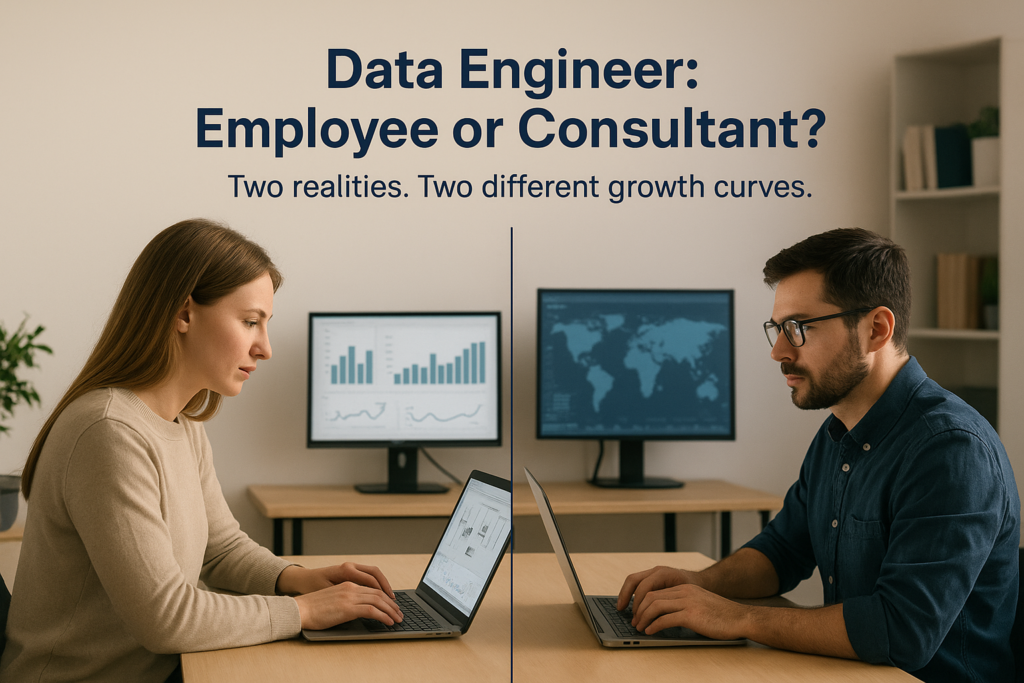
In data engineering, there are two fundamentally different ways to learn.
An employee lives inside one environment, one architecture, one business context. They see how a system evolves, how it’s adjusted over time, how the company fights with it, and eventually how the organization adapts to it. They see the long-term consequences of design choices, shortcuts, and accumulated technical debt. This perspective is valuable and a consultant never gets it.
A consultant lives in the opposite world. Every project is a new ecosystem. New architecture, new data definitions, new “truths,” new governance levels, new pipelines, new chaos. Over 6 years I worked with 26 clients, and none of them worked the same way. Documentation was often missing, logic lived only in production, CI/CD was assembled differently in every place, and time estimates almost never matched reality. Adaptation isn’t optional. It’s the entry requirement. After enough projects you start noticing the same patterns repeating across industries and tech stacks. Tools change. Company names change. The core problems do not. Pattern recognition becomes faster than most teams can even define their issue.
- An employee experiences the evolution of one system.
- A consultant experiences the variability of many systems.
- An employee sees consequences.
- A consultant sees the recurring causes.
- An employee has continuity.
- A consultant has accelerated learning.
It’s not about which path is better. Each one develops different strengths.
Consultants grow fast because constant change forces it.
Employees grow deep because they witness the entire lifecycle of a solution.
Two realities. Two types of engineers. Two types of expertise. The choice is yours.