Dashboards are designed to summarize. They aggregate, smooth, and simplify. That makes them useful for tracking progress. It also makes them blind to many of the patterns that matter most.
Most dashboards show averages, totals, and high-level trends. Hidden inside those numbers are shifts in behavior that do not change the headline metric immediately. These shifts often signal emerging problems or opportunities, but they remain invisible until their impact becomes large enough to surface.
Consider a stable conversion rate. On the surface, nothing has changed. Underneath, conversion may be improving for one segment while declining for another. The net effect is flat, but the system is already evolving. Dashboards report stability. Reality is divergence.
The same applies to usage, performance, and revenue metrics. Averages hide distribution changes. Totals hide timing shifts. Trend lines hide volatility. What looks normal at the top level can be abnormal in the details.
Dashboards also assume you know what to look for. They are passive tools. They do not highlight unusual behavior unless someone actively searches for it. As systems grow more complex, knowing where to look becomes harder.
Hidden patterns often emerge first as small deviations. A cohort behaves differently after a release. A region shows unusual latency spikes. A subset of customers starts using a feature less frequently. None of these trigger alarms. They only become obvious in hindsight.
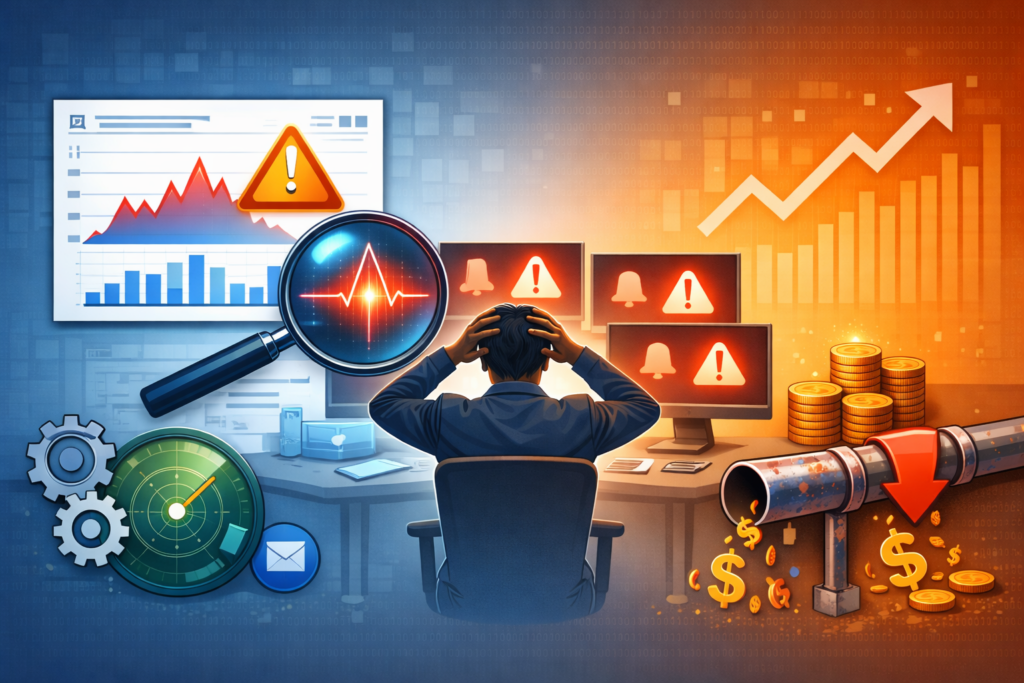
This is where anomaly detection adds value. It scans metrics continuously and flags behavior that deviates from historical patterns, even when aggregate values remain unchanged. It surfaces hidden changes without requiring teams to anticipate them.
Detection shifts analysis from exploration to awareness. Instead of asking whether something changed, teams are notified when it does. Investigation becomes focused and timely.
Platforms like AnomalyGuard are designed to reveal these hidden patterns by monitoring metric behavior across dimensions and time. They complement dashboards rather than replacing them. Dashboards explain. Detection discovers.
Teams that rely only on dashboards see what they expect. Teams that add anomaly detection see what is actually happening.
The most costly patterns are not the obvious ones. They are the quiet shifts that reshape outcomes long before anyone notices.
A quick diagnostic
Ask yourself:
Which metric would you trust less if you knew its underlying behavior had quietly changed?
If the answer is unclear, hidden patterns are likely going unnoticed.
Reviewing how metrics are monitored beyond aggregates often reveals blind spots.
That awareness is usually the first step toward early detection.